Ink and Iron: A History of Early Printing Presses

In a small, dimly lit workshop in Mainz, Germany, around 1450, a man named Johannes Gutenberg adjusted a heavy wooden screw. He wasn't just making a machine; he was engineering a way to replicate human thought at scale. This specific moment—the transition from hand-copied manuscripts to the mechanical press—changed the physical DNA of the written word forever. To understand a first edition, you have to understand the machine that birthed it. This post examines the evolution of printing technology, from the heavy timber of the Gutenberg era to the precision of the industrial revolution, and why the mechanics of a press often dictate the value and authenticity of the books in your collection.
How Did the Gutenberg Press Work?
The Gutenberg press functioned by applying even, downward pressure to a sheet of paper using a screw-driven mechanism and movable metal type. It was a hybrid of existing technology—the heavy screw used in wine and olive presses—and a new, precise way to cast individual letters. This wasn't just a way to print faster; it was a way to ensure that every "A" looked exactly like every other "A."
Before this, scribes labored for months over a single codex. The press introduced a standard of consistency that collectors look for when verifying early editions. If you see a slight variation in ink density or a slight misalignment of the type, you're looking at the physical evidence of the machine's limitations. It's the "fingerprint" of the era.
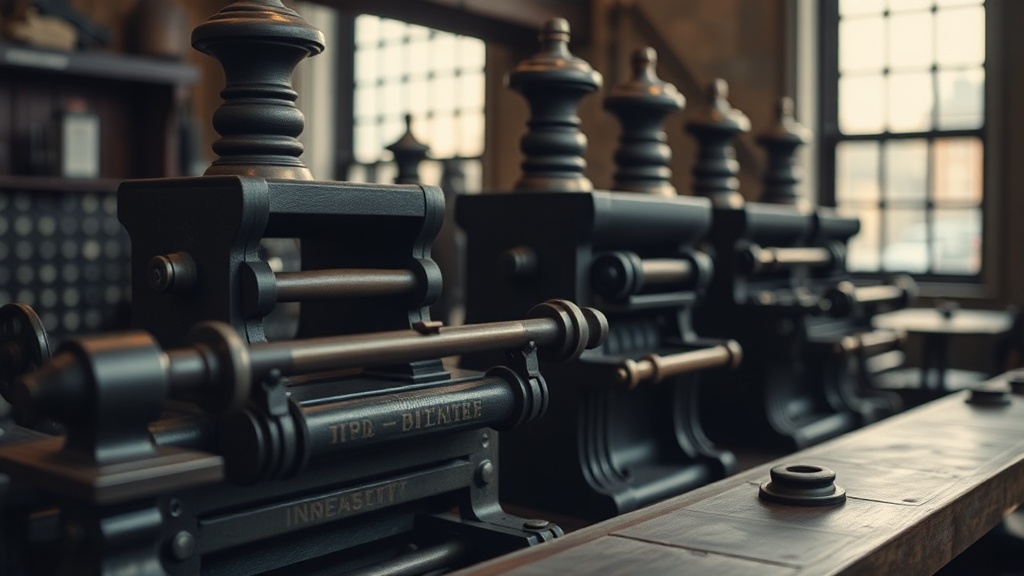
The components of a basic hand press included:
- The Platen: A flat board that distributes pressure across the type.
- The Tympan and Frisket: Frames used to hold the paper in place and protect the margins from ink.
- The Chase: A metal frame that holds the set type in place.
- The Type: Individual pieces of metal, often a lead-tin-antimony alloy, that form the words.
When you examine a book from this period, you aren't just looking at ink on paper. You're looking at the result of immense physical pressure. This pressure often leaves a subtle "bite" or indentation in the paper. If a book feels too flat or the type lacks that tactile depth, you might be looking at a modern reproduction or a later, lower-quality press run. It's worth researching the specific characteristics of the Gutenberg Bible to see how these mechanical quirks manifest in high-value items.
What Are the Differences Between Woodblock and Movable Type?
Woodblock printing involves carving an entire page into a single block of wood, whereas movable type uses individual, reusable characters. This distinction is the line between the static and the dynamic. Woodblock printing is rigid; once the block is carved, you cannot change a single letter without starting over. Movable type, however, is modular and infinitely adaptable.
Think of it like this: woodblock is a photograph, while movable type is a digital file. With woodblock, the printer is limited by the physical block. If a single character breaks or wears down, the entire page is compromised. This often leads to "broken" letters in older editions—a detail that can help a collector date a specific print run. It's a forensic detail that tells you exactly how much wear the printer's equipment had endured.
The transition from wood to metal type allowed for much higher speeds and much sharper lines. A collector can often see this in the clarity of the typeface. Metal type produces a crispness that wood simply cannot match. If you find yourself questioning the age of a text, you might want to look at identifying authentic watermarks to see if the paper quality matches the supposed era of the printing method.
| Feature | Woodblock Printing | Movable Metal Type |
|---|---|---|
| Flexibility | Very Low (Static) | High (Modular) |
| Durability | Limited (Wood wears down) | High (Metal is resilient) |
| Speed | Slow (One block per page) | Fast (Rapid assembly) |
| Detail | Softer edges | Sharp, precise lines |
How Did the Industrial Revolution Change Printing?
The Industrial Revolution shifted printing from a manual craft to a high-speed mechanical-industrial process through the introduction of steam-powered rotary presses. This transition moved us away from the slow, rhythmic pull of the hand press and into the era of mass production. The speed of production increased by orders of magnitude, making books more accessible but also creating a new set of challenges for the collector.
In the 19th century, the invention of the steam-powered press meant that printers could produce thousands of copies in the time it previously took to produce dozens. This changed the very nature of "rarity." In the hand-press era, a first edition was rare because of the labor involved. In the industrial era, rarity became a matter of how many copies were actually released versus how many survived.
One of the most significant shifts was the move from the flatbed press to the rotary press. The rotary press uses a cylinder to press the paper against the type, which allows for continuous movement. This is what made the mass-market newspaper and the cheap paperback possible. For the collector, this era is a minefield. The sheer volume of paper produced means that finding a "clean" copy—one that hasn't been battered by the sheer speed and pressure of industrial machinery—is much harder.
The materials also changed. We moved from heavy, handmade rag paper to more standardized, often more acidic, wood-pulp paper. This is a critical point for anyone managing a library. Because of the chemical composition of these later papers, they are much more prone to degradation. You'll need to be just as careful with your storage as you are with your handling. I've written extensively about the risks of light damage, so please check out my guide on protecting your collection from UV damage. The chemical breakdown of industrial-era paper is a constant battle against time.
As the machines became more complex, so did the ways to identify them. The precision of the Victorian-era presses allowed for incredible detail in typography, but it also allowed for more sophisticated forgeries. A printer's mark or a specific typeface can be a tell-tale sign of a specific press. If a book claims to be from a certain year but uses a typeface that wasn't cast until a decade later, you've found your smoking gun.
The evolution of the press is a story of pressure. It's the story of how we learned to press ideas into physical form, and how that pressure—both literal and metaphorical—shaped human history. When you hold a book, you aren't just holding a story. You're holding the mechanical footprint of the era that created it. Whether it's the heavy, uneven strike of a 15th-century press or the relentless, high-speed output of a 19th-century steam engine, the machine's signature is always there, waiting to be read.