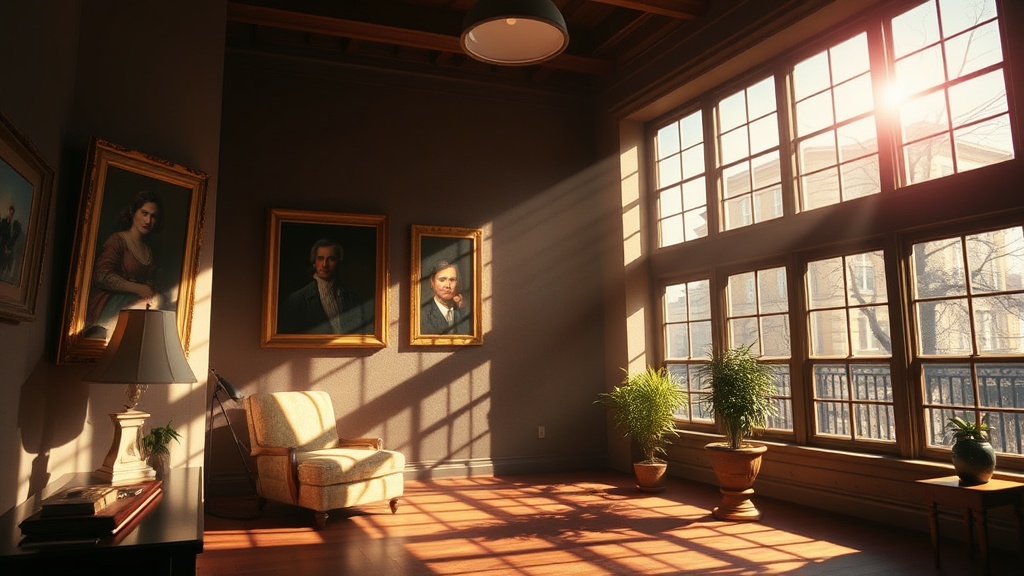
Sunlight and Shadows: Protecting Your Collection from UV Damage

Most collectors believe that if a book is kept in a dark room, it is safe from light damage. This is a mistake. Even the indirect, ambient light in a well-lit room can trigger photochemical reactions that slowly dismantle the molecular structure of paper and ink. This post examines the specific mechanics of UV degradation, the ways light-induced acidity ruins rare editions, and the practical steps you can take to shield your library from irreversible fading and brittleness.
How Does UV Light Damage Rare Books?
Ultraviolet (UV) radiation breaks down the chemical bonds in cellulose fibers and organic pigments through a process called photodegradation. It's not just about the color fading; it's about the structural integrity of the object itself. When UV rays hit a book, they act like a slow-motion wrecking ball on a microscopic level. They trigger oxidation, which leads to the yellowing of pages and the eventual crumbling of the paper.
Think of it as a slow burn. A single afternoon of direct sunlight through a window can do more damage to a leather binding than a decade of dim candlelight. The light energy is absorbed by the pigments in the ink and the dyes in the cloth or leather. This energy causes the molecules to vibrate and eventually break apart. The result? A first edition that once boasted a vibrant, deep blue cloth binding might end up a pale, sickly grey within a few years.
It's particularly brutal on organic materials. Leather bindings, which are made of animal skin, are highly susceptible to "red rot"—a condition where the leather becomes brittle and turns to dust. While acidity in the paper is a major factor, light-induced oxidation accelerates this decay. If you've ever noticed a book's spine looking significantly lighter than its interior, you've witnessed a crime scene in progress.
The physics of this is documented extensively by organizations like the Library of Congress, which provides rigorous standards for the preservation of paper-based materials. They emphasize that light is a form of energy that can't be "undone" once it has caused a change in the substrate. You can't "re-dye" a 1925 Gatsby first edition back to its original luster once the photons have stripped the pigment away.
One of the most common culprits is the "invisible" light. Even if you can't see a bright glare, the high-energy wavelengths are still present. This is why many collectors keep their books in closed cabinets, but even then, the light that enters when the cabinet is opened counts toward the total "light dose" the object receives.
What Are the Best Ways to Protect Books from Light?
The most effective way to protect your collection is to control the light source through physical barriers and UV-filtering technology. You can't eliminate light entirely if you want to see your books, but you can certainly mitigate the damage. There are three primary layers of defense: placement, window treatments, and display housing.
First, placement is your first line of defense. Never store a high-value collection in a room with large, unshaded windows. Even if the books aren't in direct sunlight, the ambient UV levels in a sun-drenched room are high enough to cause long-term issues. If you must display a first edition, do it in a room with controlled, low-level lighting rather than a bright sunroom or a room with large skylights.
Second, address the windows. If your library is near a window, you need to treat that window. Standard glass does very little to block UV rays. You can use UV-filtering films, such as those produced by 3M, which adhere directly to the glass. These films can block up to 99% of harmful UV radiation without significantly altering the look of the room. It’s a relatively inexpensive way to protect your entire room, not just one book.
Third, use protective housing. For your most precious items, a custom-made clamshell box (also known as a chemise or a solander box) is the gold standard. These boxes provide a physical barrier against both light and dust. If you are displaying a book on a shelf, consider using archival-grade acrylic covers. These are much more effective than standard plastic than they are at blocking UV than cheap, flimsy covers.
Here is a quick comparison of common light-mitigation methods:
| Method | Effectiveness | Primary Benefit | Best For |
|---|---|---|---|
| UV-Filtering Window Film | High | Protects the entire room | Permanent libraries/studies |
| Clamshell/Solander Boxes | Very High | Complete light isolation | High-value first editions |
| LED Lighting (Low UV) | Medium | Reduces heat and UV output | General display/reading |
| Blackout Curtains | Blocks all visible/UV light | Rooms with direct sun exposure |
When selecting light sources for your library, stick to LEDs. Older incandescent bulbs and even some fluorescent tubes emit much higher levels of UV and heat. LEDs are "cool" lights, meaning they don't radiate the thermal energy that can dry out leather and glue. This is a small but vital detail. A book that is being "cooked" by a hot bulb is just as much at risk as one being "bleached" by the sun.
How Much Light Exposure is Safe for Paper?
There is no single "safe" amount of light because every book has a different threshold of resistance based on its chemical composition. However, the general rule in the archival world is that the less light, the better. A book made of high-quality, acid-free paper from the late 20th century will withstand much more light than a 19th-century rag paper or a cheap wood-pulp paper from the early 1900s.
The more "acidic" the paper, the more vulnerable it is to light. This is a critical distinction. When light hits acidic paper, it accelerates the chemical reaction that creates more acid, which in turn makes the paper more brittle. It’s a feedback loop of destruction. This is why I often remind collectors that identifying the quality of the paper is just as important as identifying the edition itself.
If you are a serious collector, you should think in terms of "lux." Lux is a measure of light intensity. For a museum-grade environment, light levels are kept extremely low—often under 50 lux for sensitive organic materials. While you won't be able to run a library at 50 lux (you'd be reading in the dark), you should aim to keep your display light levels as low as possible. Avoid "spotlighting" a single book with a bright halogen lamp. That is essentially a death sentence for the binding.
A good rule of thumb: if you can see the book clearly without any artificial light, the light levels are likely too high for long-term display. If you need to turn on a lamp to see the title, that lamp should be turned off the moment you are done. Constant exposure is the enemy. Intermittent exposure is a manageable risk.
If you're worried about the physical handling of these books during display or inspection, remember that light isn't your only enemy. Oils from your skin can react with the light and accelerate degradation. I've written extensively about the importance of using cotton gloves to prevent these chemical-light interactions. It's all part of the same protective mindset.
The goal isn't to create a tomb for your books. You want to enjoy them. But a collector's job is to be the steward of these objects. You are the one responsible for ensuring that the physical evidence of history doesn't vanish under the glare of a well-meaning lamp. Treat your library like a crime scene—keep the evidence preserved, controlled, and protected from the elements.