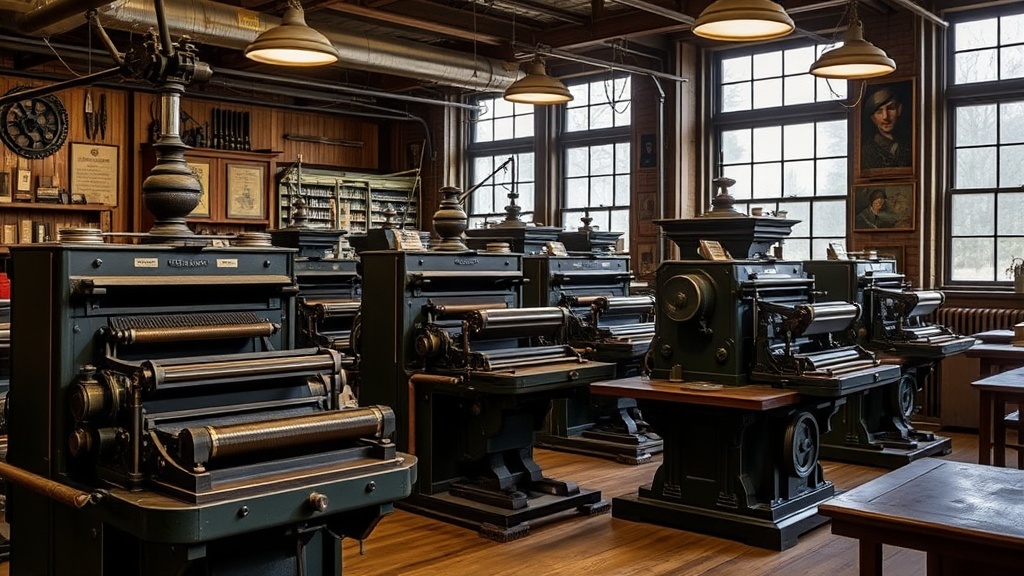
Ink and Iron: 4 Rare Printing Presses That Changed Literary History

The Gutenberg Revolution: The Wooden Hand Press
The Stanhope: The First All-Iron Press
The Albion: Precision in the Victorian Era
The Steam-Powered Giant: Industrial Scale Printing
This article examines four pivotal printing presses that fundamentally restructured the distribution of human thought, focusing on the mechanical evolution from wooden hand-presses to industrial iron machinery. You will learn the specific mechanical distinctions of these machines, the technological breakthroughs they introduced, and how these innovations directly influenced the physical characteristics of the first editions sought by modern collectors.
To understand a rare book, one must first understand the machine that birthed it. A book is not merely a collection of words; it is a mechanical imprint of a specific moment in engineering. When examining a specimen, the pressure of the type against the substrate—be it vellum or rag paper—reveals the very soul of the press used. The transition from wood to iron was not merely a change in material, but a revolution in the precision of the printed word.
1. The Gutenberg Press: The Wooden Foundation of the Renaissance
The movable type printing press, perfected by Johannes Gutenberg in Mainz, Germany, around 1450, remains the most significant mechanical pivot in human history. Unlike the woodblock printing techniques used in East Asia, Gutenberg’s innovation relied on the synthesis of three distinct technologies: oil-based ink, a screw-driven press, and a precision-cast metal alloy for the type itself.
The Gutenberg press was a wooden structure, essentially a modified wine or olive press. It utilized a heavy wooden screw to apply vertical pressure to a flat platen. This pressure was distributed across a bed of type, which was positioned under the platen. The mechanical limitation of this press was its inconsistency; because it was made of organic wood, the machine was subject to warping, humidity, and uneven pressure. This often resulted in "heavy" impressions on one side of a page and "light" impressions on the other.
For the collector, identifying a true incunabulum (a book printed before 1501) requires looking for these subtle mechanical signatures. Look for the impression depth. In a Gutenberg-era press, the type often leaves a slight indentation in the thick, handmade rag paper. This physical "bite" is a hallmark of the wooden screw press. Furthermore, the ink used was a thick, viscous mixture of linseed oil and soot, which sat atop the fibers rather than soaking in, a characteristic that distinguishes it from the thinner, water-based inks used in later eras.
Understanding the chemical composition of these early materials is essential for long-term care. To learn more about the tactile and olfactory qualities of these early materials, see our guide on identifying authentic antique paper fragrances, as the scent of aged linseed oil and organic decay is a primary indicator of a true Gutenberg-era specimen.
2. The Blaeu Press: The Perfection of the Wooden Hand-Press
By the 17th century, the wooden press had reached its zenith through the refinements of Willem Janszoon Blaeu. While the fundamental mechanism remained a wooden screw, Blaeu introduced critical improvements to the "tympan" and "frisket"—the frames that hold the paper in place during the printing process. This allowed for much cleaner margins and more consistent ink distribution.
The Blaeu press was the workhorse of the Dutch Golden Age, the era that produced the most exquisite cartography and scientific illustrations in history. The mechanical advantage of the Blaeu press lay in its improved stability. By refining the way the platen descended, printers could achieve a much higher degree of uniformity. This was essential for the intricate copperplate engravings that were often printed alongside movable type in high-end volumes.
When inspecting a 17th-century Dutch volume, look for the precision of the margins. A Blaeu-era press produces a page with remarkably consistent white space. If you observe a book where the text block is perfectly centered with minimal "bleeding" or unevenness in the pressure, you are likely looking at the result of this refined mechanical precision. The interplay between the metal type and the copperplate engraving often requires two separate passes through the press, a process that demands the high level of mechanical consistency that the Blaeu design provided.
3. The Stanhope Press: The Iron Revolution
The transition from wood to iron in the early 19th century changed the scale of human knowledge. Charles Stanhope, the 3rd Earl Stanhope, developed the first all-iron press around 1800. This was not a minor upgrade; it was a fundamental shift in the physics of printing. The wooden press had a physical limit to how much pressure it could exert before the frame itself began to flex or break. The Stanhope press, constructed of cast iron, eliminated this structural instability.
The primary innovation of the Stanhope press was the use of a lever rather than a screw. Instead of rotating a heavy wooden screw to apply pressure, the printer pulled a long iron lever. This lever-action allowed for a much greater and more controlled application of force. This meant that printers could finally print on much larger sheets of paper with a single pull, drastically increasing the speed and volume of production.
For the collector of 19th-century literature, the Stanhope press is the reason for the sudden increase in the quality of large-format books and periodicals. Because the iron frame did not flex, the "type impression" became much more uniform across the entire surface of the page. When examining a first edition from the early 1800s, check for the "crispness" of the type. An iron-press book will often exhibit a level of detail in the fine lines of the typeface that a wooden press simply could not achieve. The pressure is more decisive, resulting in a sharper, more legible character.
4. The Koenig & Bauer Cylinder Press: The Birth of Mass Production
If the Stanhope press brought precision, the Koenig & Bauer steam-powered cylinder press brought velocity. In the early 1810s, Friedrich Koenig and Andreas Bauer revolutionized the industry by replacing the flat platen with a rotating cylinder. This machine, which utilized steam power to drive the movement, moved the printing process away from a manual, human-scaled endeavor to an industrial-scale operation.
The cylinder press works by passing a continuous sheet of paper under a rotating cylinder that carries the inked type. This movement is far more efficient than the "up-and-down" motion of the traditional platen press. It allowed for the birth of the modern newspaper and the mass-produced book. The mechanical tension required to keep a rotating cylinder in perfect alignment with a moving sheet of paper is immense, requiring rigorous engineering and constant calibration.
The impact on the physical book was profound. The cylinder press allowed for the production of much thinner, cheaper paper, as the machine could handle the high speeds and the pressure of the cylinder. However, this also led to the era of "industrial" paper, which is often more acidic and prone to degradation than the rag papers of the previous centuries. When collecting books from this transitionary period, one must be vigilant about the quality of the substrate. The speed of the cylinder press often meant that the ink had less time to set, sometimes leading to "offsetting" or slight blurring of the type if the paper was not handled correctly.
To truly understand the provenance and the material history of these industrial-era books, it is vital to look beyond the text and into the very fibers of the paper. For a deeper look into the history of these materials, explore the history of early printing, ink, and parchment.
The Collector's Checklist: Identifying the Press
When you are holding a potential first edition, use these three diagnostic steps to attempt to identify the mechanical "witness" to its creation:
- Check the Impression Depth: Use a low-angle light source (a raking light) across the page. If you see a distinct indentation or "bite" in the paper, you are likely looking at a wooden or early iron press. If the surface is relatively flat, it is more likely a later cylinder or offset press.
- Analyze Margin Consistency: Examine the white space around the text block. High uniformity suggests the stability of an iron press (Stanoke) or a highly refined cylinder press. Irregularity or "heavy" sides suggest the organic limitations of a wooden Gutenberg or Blaeu press.
- Examine Type Detail: Use a jeweler's loupe to look at the fine serifs and thin lines of the characters. The sharpness of these lines can tell you if the pressure was applied via a vertical screw, a lever-action, or a rotating cylinder.
Every book is a forensic artifact. By understanding the iron and the ink that formed it, you move from being a mere owner of a book to a true historian of the printed word.