Ink, Parchment, and Provenance: Tracing the History of Early Printing

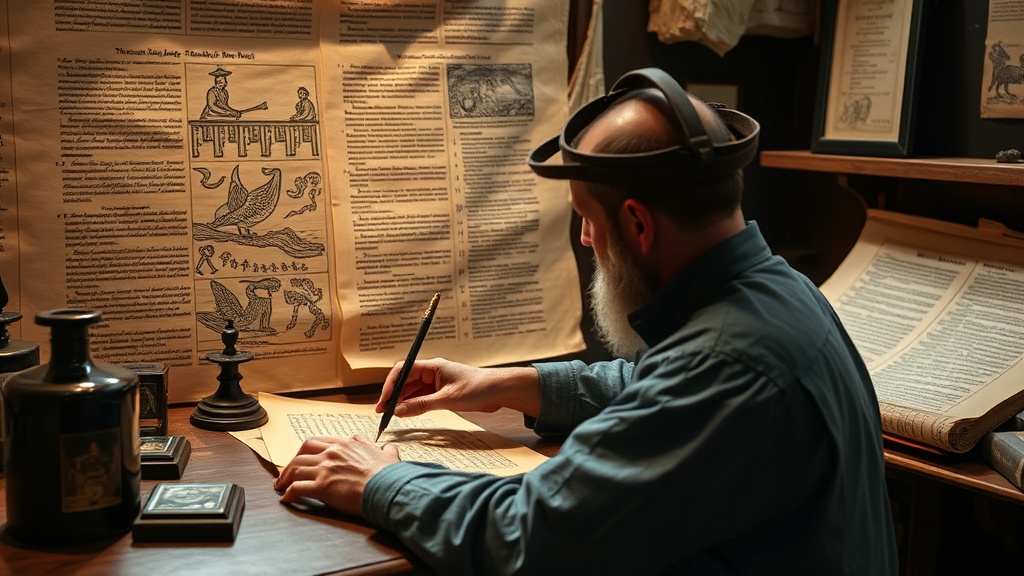
The air in a high-medieval scriptorium is heavy with the scent of iron gall ink and the sharp, acidic tang of scraped animal skin. A single shaft of light pierces the gloom, illuminating the microscopic imperfections in a sheet of vellum—the tiny, fossilized pores of a calf or sheep. Here, every character is a physical labor, a deliberate strike of the quill that carries the weight of human fatigue and religious devotion. To hold a manuscript from this era is not merely to read a text; it is to hold a biological artifact, a piece of once-living matter that has been transformed into a vessel for thought.
Tracing the history of printing is an exercise in forensic investigation. We are not just looking at the evolution of technology, but at the transformation of the very DNA of human communication. To understand the transition from the hand-copied codex to the mechanical press, one must look closely at the material evidence: the way ink sits upon a surface, the texture of the substrate, and the microscopic "footprints" left by metal type.
The Era of the Scribe: The Materiality of the Codex
Before the mechanical revolution, the "book" was a bespoke object. In the 12th and 13th centuries, the standard medium was parchment or vellum. Unlike modern paper, which is a pulp-based product, parchment is a structural material. It is skin, often prepared through a process of liming, scraping, and stretching over a wooden frame called a herse. As a collector, identifying the substrate is your first step in dating an object. A high-quality uterine vellum, for instance, possesses a translucency and smoothness that distinguishes it from the coarser, more irregular sheepskin used for utilitarian texts.
The ink used during this period was often iron gall, a permanent, corrosive substance made from oak galls (growths caused by wasps) and ferrous sulfate. Under a jeweler's loupe, iron gall ink reveals its true nature: it does not merely sit on top of the page like modern pigment; it bites into the fibers. Over centuries, this acidity can cause "ink burn," where the text literally eats through the parchment. When you encounter this, you are seeing the chemical signature of the scribe's hand—a physical testament to the chemical composition of the medieval workshop.
The Incunabula Period: The Birth of the Typeface
The mid-15th century marks the most significant pivot in the history of the written word: the arrival of the printing press. The term incunabula refers specifically to books printed in Europe before the year 1501. These are the "infant" books, the transitional specimens that bridge the gap between the manuscript and the modern printed book. During this era, printers like Johannes Gutenberg in Mainz or Aldus Manutius in Venice were not just inventing a machine; they were attempting to mimic the aesthetic of the scribe.
Early printers utilized Blackletter or Textura typefaces to replicate the dense, angular look of Gothic handwriting. If you examine a specimen from the Gutenberg era, you will notice the "bite" of the type. Because the press applied immense pressure to force the metal type into the dampened paper, the letters often leave a slight indentation on the reverse side of the page. This is known as "type impression," and it is a primary diagnostic tool for distinguishing an early print from a later, flatter lithographic reproduction.
- The Gutenberg Bible: The gold standard of incunabula, utilizing movable metal type and high-quality rag paper.
- Aldine Press Editions: Famous for introducing the italic typeface and the smaller, portable "octavo" format, which revolutionized how books were carried and read.
- The Substrate Shift: The move from parchment to rag paper (made from linen and hemp fibers) allowed for faster, cheaper production, though it changed the tactile experience of the text entirely.
The Mechanics of the Press: Metal, Wood, and Pressure
The transition from the wooden hand press to the more sophisticated iron presses of the 19th century is a study in mechanical evolution. The wooden press, perfected by Johannes Gutenberg and refined by later craftsmen, relied on a screw mechanism to apply pressure. This required a precise, rhythmic human element. The printer had to "ink the type" with leather-covered ink balls, a process that required a specific level of dexterity to ensure an even distribution of pigment across the metal characters.
As we move into the 18th and 19th centuries, the chemistry of printing undergoes a radical shift. The introduction of copperplate engraving and steel engraving changed the way visual information was recorded. Unlike relief printing (where the raised surface holds the ink), intaglio printing involves incising lines into a metal plate. The ink is forced into these grooves, and the paper is pressed into them with immense force. This creates a distinct "plate mark"—a physical indentation around the edge of the printed image that serves as a hallmark of authenticity for collectors of early botanical or topographical prints.
For the serious collector, understanding these mechanical nuances is vital. A genuine 18th-century engraving will possess a depth and a "feel" to the lines that a modern offset lithograph, which merely sits on the surface of the paper, can never replicate. You can learn more about identifying these nuances by studying the language of bookplate ex libris, which often provides clues to the previous owners and the historical context of such high-quality printed works.
The Industrial Revolution and the Rise of Wood Engraving
By the mid-19th century, the demand for mass-produced imagery led to the perfection of wood engraving. Unlike woodcuts, which use the side grain of the wood, wood engraving uses the end grain of hard woods like boxwood. This allows the engraver to use much finer, more intricate lines, making it possible to print detailed illustrations directly alongside movable type on a standard press. This was the engine of the Victorian era's "illustrated news," fueling the popularity of magazines and serialized novels.
To the trained eye, a wood engraving exhibits a specific grain structure and a certain density of line that distinguishes it from the softer, more organic look of a woodcut. The precision of the end-grain allows for microscopic detail, a hallmark of the era'ary high-production standards. However, this era also brought about the "death of the unique object," as the speed of the steam-powered press meant that thousands of identical copies could be produced, fundamentally altering the concept of rarity and provenance.
The Collector's Checklist: Forensic Indicators of Age
When examining an early printed work, do not rely on the title page alone. The title page can be forged or replaced; the physical evidence of the paper and ink is much harder to manipulate. Use the following criteria to assess the physical history of your specimen:
- Paper Texture and Composition: Hold the page up to a light source. Does it show "laid lines" (the pattern left by the wire sieve used in paper making)? Does it have "chain lines"? Modern paper is often too uniform; antique rag paper has a characteristic irregularity and a "tooth" that responds to the light.
- Ink Saturation: Look for the "halo" effect. In older printing methods, the ink often bleeds slightly into the fibers of the paper, creating a soft edge. Modern digital or offset printing often appears unnaturally sharp or perfectly uniform.
- The "Bite" of the Type: Run a finger (carefully) or use a raking light to see if the type has left an impression in the paper. This is a critical indicator of a letterpress print.
- Edge Wear and Foxing: While often seen as defects, "foxing" (the reddish-brown spots caused by fungal growth or iron oxidation in the paper) can actually serve as a biological timestamp, provided it is consistent with the age of the material.
As you refine your ability to read these physical clues, you must also consider the long-term survival of these artifacts. The very qualities that make them fascinating—the organic nature of the parchment, the acidity of the ink, the fragility of the rag paper—also make them vulnerable to the environment. To ensure these witnesses to history endure, you must master the art of preserving your rare first editions, treating them not just as assets, but as delicate, living histories.
Conclusion: The Witness in the Archive
Every book is a survivor. It has survived the damp of a library, the heat of a candle, the passage of centuries, and the shifting tides of human interest. When we trace the history of printing, we are not merely studying a timeline of machines; we are studying the evolution of the human imprint. From the slow, deliberate stroke of a quill on vellum to the rapid-fire strike of a mechanical press, each method has left a permanent mark on the world. As collectors, our job is to look past the text and see the object itself—the ink, the parchment, and the profound, physical reality of history.