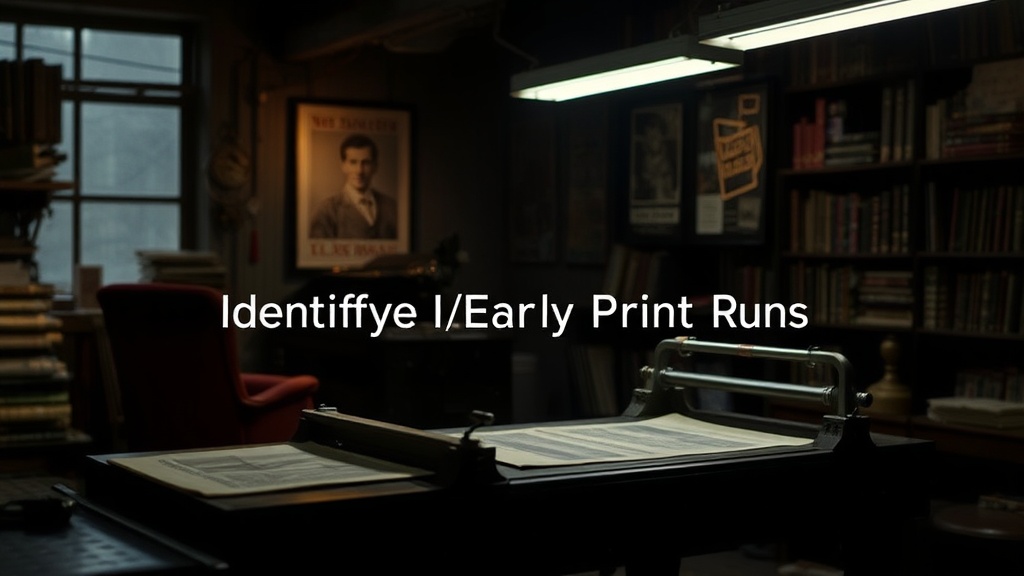
Tracing the Ghost of the Ink: Identifying Early Print Runs

The Weight of a Single Mistake
A single errant letter in a first edition can be the difference between a common reprint and a museum-grade specimen. In the world of bibliophily, we don't just look at the words; we look at the mechanical failures that occurred during the press run. When a printer realizes a mistake was made mid-run, they might attempt a 'stop-press' correction, or they might simply finish the run and label it differently. This physical evidence—the microscopic variations in ink density, the slight shifts in typeface alignment, and the texture of the paper—serves as the DNA of a book's production. Understanding these nuances allows a collector to distinguish between a true first state and a later, less significant impression.
Detecting these variations requires more than a keen eye; it requires a forensic mindset. You aren't just reading a story; you're analyzing a manufacturing process. Every press run has a rhythm, and when that rhythm breaks, it leaves a mark. Whether it's a broken piece of type or a smudge of excess ink, these flaws are the fingerprints of the printer's workshop. We study them because they tell us exactly when a book was born.
What Marks an Early Print State?
Identifying the earliest state of a publication involves looking for specific material inconsistencies. Often, the first state is characterized by 'errors' that were corrected in subsequent printings. For instance, a misplaced comma or a misspelled word in a title page might be fixed in the second state, making the error itself a mark of rarity. You must look for:
- Typeface Wear: In older letterpress printing, the metal type would degrade over time. The first state often features sharper, crisper edges on the letters, whereas later prints show slight blurring or 'bleeding' as the type wears down.
- Ink Saturation: Early in a print run, the ink is often more consistent. As the press continues to run, the ink distribution might become uneven, leading to lighter or darker patches across the page.
- Paper Grain and Weight: Changes in the paper stock can signal a shift in production. A first edition might use a heavier, more textured rag paper, while later editions might move to a thinner, more standardized wood-pulp paper to save costs.
If you're investigating a specific volume, check the Library of Congress digital collections to see how different editions of the same work appear. The visual evidence of a print's evolution is often found in these subtle shifts in material quality.
Why Does Paper Quality Change Between Editions?
The transition from one print run to another is rarely just about the text; it's about the industrial reality of the time. A printer might run out of a specific grade of paper and be forced to use a substitute. This change is a vital clue. If you find a book that claims to be a first edition but uses a paper stock that wasn't commercially available until five years later, you've uncovered a discrepancy. This is where the detective work pays off. The physical medium is often more honest than the title page.
A common example is the move from handmade paper to machine-made paper during the industrial revolution. Collectors look for the transition points where the texture of the page shifts from a creamy, irregular surface to a smoother, more uniform one. This shift can help you pin down the exact window of production. To understand more about the history of paper manufacturing, the British Library provides extensive documentation on the evolution of print media and material science.
How Do You Spot a False First Edition?
The most dangerous trap for a collector is the 'false first.' This occurs when a publisher releases a second or third printing that looks nearly identical to the first, but with slight, often undocumented, changes. These are the ghosts in the machine. To avoid being misled, you must become obsessed with the minutiae. A false first often lacks the specific 'errors' that the true first is famous for. If the 'typo' everyone talks about is missing, you might be holding a later, less valuable version.
Consider the following checklist when inspecting a potential first edition:
- Examine the Colophon: The colophon (the publisher's note at the end of the book) can be a goldmine. It often contains clues about the number of copies printed or the specific type of press used.
- Compare the Binding: While a book can be rebound, the original binding is part of its historical identity. If the binding feels too modern for the supposed era of the text, treat it as a red flag.
- Check the Signature Marks: These are the small letters or numbers at the bottom of pages used to guide the binder. Variations in these marks can indicate a different stage in the assembly of the book.
Always assume the book is lying to you until the physical evidence proves otherwise. The title page tells you what the book wants to be; the paper, the ink, and the type tell you what the book actually is. This distinction is the foundation of serious collecting.
The Forensic Toolkit: Tools for the Collector
You don't need a laboratory, but a few simple tools can change your perspective. A high-powered jeweler's loupe is your best friend. It allows you to see the way the ink sits on the fibers of the paper. Under magnification, you can see if the ink is 'sitting' on top of the page or if it has been absorbed deeply. This distinction can reveal whether a book was printed via letterpress or a later offset method. A light-source check—using a strong, angled light to observe the way the paper reflects light—can also reveal watermarks or texture changes that are invisible to the naked eye.
When you're looking at a book through a lens, you're no longer just a reader. You're an investigator looking at a crime scene. The 'crime' is the loss of detail through time and the gradual degradation of the printing process. Every smudge, every frayed edge, and every uneven line of text is a piece of testimony. Treat the book with the respect a witness deserves, and it will tell you exactly where it came from.