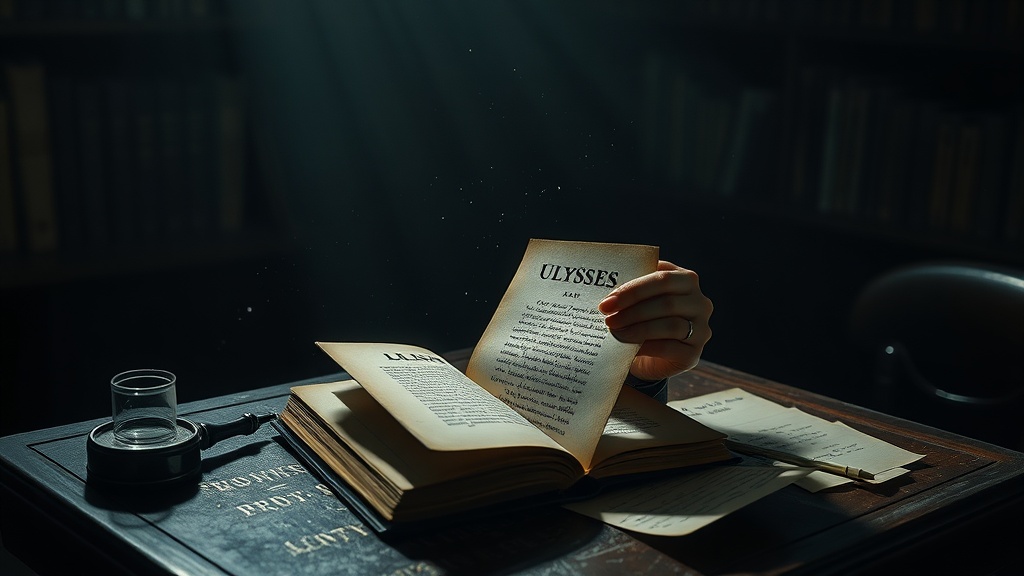
The Invisible Spine: Women Who Built the Rare Book World and Got Filed Under 'Miscellaneous'

There's a copy of the first edition of Ulysses — Paris, Shakespeare and Company, 1922 — that sold at Christie's a few years ago for just under $400,000. Blue-grey wrappers, Darantière imprint, one of the nine hundred copies on regular paper. The catalogue note ran to six hundred words. It named Joyce eleven times. It named Darantière, the Dijon printer, twice. It named Harriet Shaw Weaver — who had long supported Joyce financially and made her own unsuccessful attempts to publish the novel through The Egoist Press in London — once, in passing. It named Sylvia Beach zero times.
Sylvia Beach published that book.
She was the one who agreed to take it on after every major house had refused. She was the one who managed the correspondence, the subscribers, the print run, the corrections — eleven rounds of proofs, Joyce revising compulsively on every pass. She was the one who handed the first copy to Joyce on his fortieth birthday, February 2, 1922, and stood there while he wept. Without Sylvia Beach, there is no first edition of Ulysses. There is no Christie's lot at any price. There is no modernist canon as we understand it. There is just a manuscript, sitting in a drawer in Paris, unpublished.
The catalogue gave her nothing. The bibliography gives her everything — you just have to know where to look.
What the Market Keeps Losing
I've been running the rare book circuit for almost fifteen years now, five of them in Manhattan where the money concentrated, the last decade in New England where the real collections are hidden in estates and attics and the occasional church sale. In that time I've watched the field perform a particular vanishing act with reliable consistency: the women who did the essential intellectual labor get filed under "miscellaneous" while the men who benefited from that labor get the endowed chairs and the dictionary entries.
This is not a rant. I don't do rants — I do forensics. And the forensic record, in case after documented case, tells the same story.
Let me give you a few specimens.
Frances Steloff and the Books Nobody Wanted
In 1920, a twenty-nine-year-old from Saratoga Springs named Frances Steloff opened Gotham Book Mart at 128 West 45th Street in Manhattan. She had $175 in savings and no formal education beyond high school. Within a decade she had created the most important literary bookshop in America.
"Wise men fish here" — the famous sign above the door, which she kept through seven decades of operation.
What Steloff understood, at a moment when the rare book market was still primarily interested in nineteenth-century standards and gentlemen's library respectability, was that the next generation of collectible firsts was being printed right now. She stocked Henry Miller when he was banned. She stocked D.H. Lawrence when the post office was confiscating copies. She stocked Gertrude Stein, Djuna Barnes, Anaïs Nin — authors whose first editions would later command five figures at Christie's, whose work she kept alive during the decades when nobody else would touch them.
The Gotham Book Mart archive, if you ever have occasion to study it, is a masterclass in taste as investment thesis. She sold first editions of what would become the cornerstone pieces of twentieth-century American literature to writers, critics, and collectors who were themselves becoming the next generation of canonized figures. Her client list reads like a course syllabus: Pound, Eliot, Cummings, Williams, Auden. They came because she had the books. She had the books because she had the judgment.
When scholars discuss the formation of the American modernist first edition market, Steloff's name appears, if at all, in a dependent clause. The books she handled — her selections, her relationships with publishers, her thirty years of sustained institutional commitment to the avant-garde — those books appear in the auction catalogues with full bibliographic dignity. She appears as a footnote.
The bibliography never lies. But the footnote machine has its own agenda.
Fannie Ratchford and the Brontë Archive
In 1941, a librarian named Fannie Elizabeth Ratchford published The Brontës' Web of Childhood, a study of the juvenile manuscripts Charlotte and Branwell Brontë had produced as children — the Angria and Gondal cycles, tens of thousands of words written in microscopic script in tiny hand-sewn pamphlets. She had spent years tracking down these manuscripts across institutions and private collections, transcribing them, establishing a chronology, and arguing that they constituted a serious literary archive rather than charming biographical curiosity.
The rare book world's interest in Brontë manuscripts was already fierce by then — partly because T.J. Wise, the bibliographer and forger, had been busy creating fake Victorian pamphlets attributed to Tennyson, Browning, and others, and the forgery anxiety had sent collectors reaching for authenticated provenance documentation on everything. The Brontë juvenilia were particularly vulnerable because their physical properties — tiny, handmade, produced by children with no printer's notation — made verification genuinely difficult.
Ratchford's scholarly groundwork became the authentication baseline for the entire field. Her decades of work at the University of Texas at Austin — where she served in the rare books operation from the 1920s until her retirement in the late 1950s, building what became one of the major literary manuscript repositories in the country — established the institutional protocols that still shape how research libraries handle literary manuscripts. She trained the field. She established the standards. She wrote the bibliography.
When you see a Brontë manuscript item in a major auction catalogue today, the provenance notes are tracing a chain that Ratchford helped build. Her name may appear; more often it doesn't. What appears are the conclusions of her work, stripped of attribution, laundered through decades of subsequent scholarship until they've achieved the neutral authority of received truth.
That's how it works. The women do the primary research. The primary research becomes the field. The field forgets who dug the foundation.
Mary Hyde and the Johnson Archive
If you want to understand what a serious private collection looks like at its apex, you need to know about Mary Hyde — later Viscountess Eccles — and the Four Oaks Library she assembled with her first husband, Donald Hyde, beginning in the 1940s.
The Hydes built the definitive private collection of Samuel Johnson and James Boswell materials. First editions, manuscripts, letters, association copies — the kind of assemblage that takes not just money but deep bibliographic knowledge, relationships with dealers on three continents, and the patience to track a single significant item for years before it surfaces. When Donald Hyde died in 1966, Mary continued collecting. The library grew more extraordinary. She became the world authority on Johnson's biography and correspondence — publishing scholarship, advising major institutions, cataloguing her own holdings with a rigor that put most academic libraries to shame.
The Hyde collection ultimately went to Harvard's Houghton Library. It is one of the great gifts in American library history. The catalogue of the collection, which Mary Hyde compiled and edited, remains a model of bibliographic scholarship.
In the rare book trade, "Hyde provenance" on a Johnson or Boswell item is the provenance. It's the gold standard. A book that passed through the Four Oaks Library carries with it the implicit guarantee of rigorous authentication and expert handling.
But ask a general antiquarian who built the Hyde Collection in its mature form, who drove the scholarship that gave "Hyde provenance" its authority — ask them who the expert behind the library was — and you will sometimes get Donald Hyde's name. Donald Hyde died in 1966. Mary Hyde lived and worked until 2003. The collection's greatest period of growth and scholarly output happened under her sole stewardship. She had thirty-seven years after his death to keep building what they'd started. She did.
The bibliography knows. The casual attribution doesn't always.
Back to Beach
I want to close where I started.
The first edition of Ulysses — any copy, in any condition — is one of the benchmark items in twentieth-century literature collecting. The bibliographic points are well established: the title page "SHAKESPEARE AND COMPANY / 12, RUE DE L'ODÉON, PARIS" imprint, the Darantière colophon, the edition statements ("First edition," followed by the copy number for signed copies, without for the nine hundred standard). Fine copies of the regular edition have cleared $250,000 to $400,000 range at recent auction — a range that shifts with condition, provenance, and the room — while signed, numbered copies from the one hundred on Dutch handmade paper go considerably higher.
Every one of those copies exists because Sylvia Beach said yes.
She ran Shakespeare and Company on a shoestring, negotiating with printers, managing subscribers who defaulted, keeping Joyce solvent through a combination of sales, advances, and what amounted to personal subsidy. The operational infrastructure of the most important literary publishing decision of the twentieth century ran through her. She had the judgment to recognize that Ulysses was something the world needed and the will to make it exist.
The Christie's lot does not exist without her. The entire aftermarket for Joyce firsts — the signed copies, the subscription copies, the later printings with documented provenance — none of it exists without the publishing decision she made in 1921.
I'm not asking the market to retroactively rewrite its catalogues. I'm asking for the bibliographic honesty that the field claims as its highest value. The bibliography is supposed to be the final authority. The bibliography doesn't get to be selective about whose work it credits.
What You're Actually Holding
Here's the practical note, because I try to give you one.
When you're at an estate sale or an auction preview and you're handling a modernist first — anything from the period 1920 to 1960 when the small presses and independent bookshops were the institutional infrastructure of American literary culture — the provenance chain matters beyond its market function. It tells you who had this book, who thought it was worth keeping, who understood what it was.
If you see Gotham Book Mart in the provenance — Steloff's shop, the "Wise men fish here" shop — that's not just a dealer notation. That's a document of what one woman knew and decided to keep in print.
If you see Hyde provenance on a Johnson item, understand that you're holding a book that passed through one of the century's most rigorous private bibliographic operations, mostly administered by a woman who spent thirty-seven years making the field's foundations stronger.
International Women's Day lands in two days. The rare book market will mark it, if at all, by selling a signed George Eliot or a Charlotte Brontë letter with appropriately inflated estimates. It won't linger on Steloff, or Ratchford, or Beach, or Hyde — the women who were the infrastructure, not the product.
The bibliography knows. The bibliography always knows.
Happy hunting.
— J.V., Filed from Providence, 1:47 PM