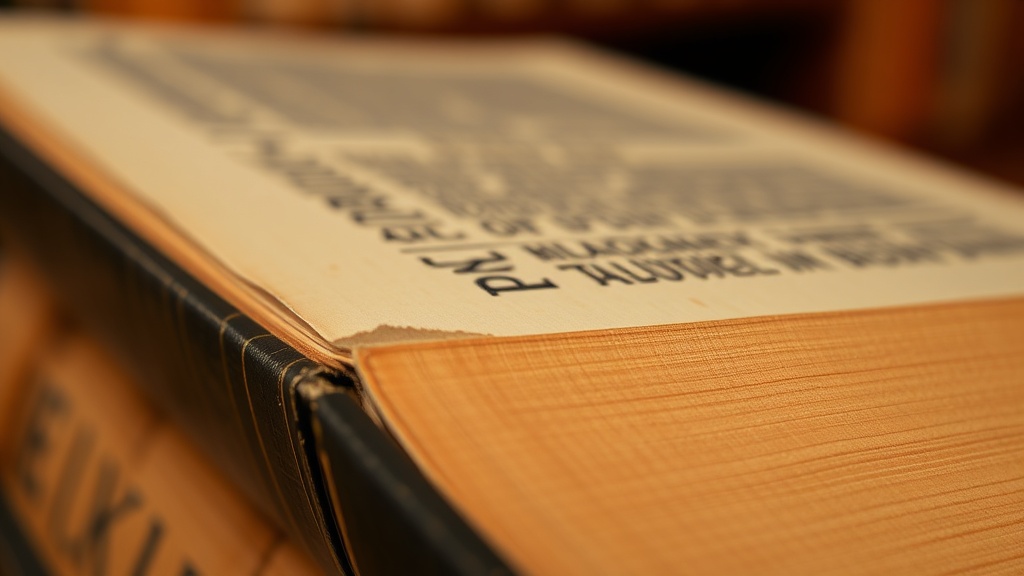
The Gutter Margin: What Binding Wear Tells You That the Seller Won't

The Gutter Margin: What Binding Wear Tells You That the Seller Won't
Every book has a spine story, and most sellers hope you never learn to read it.
I have turned down more first editions based on what the binding told me than on any other single factor—more than foxing, more than faded cloth, more than a chipped dust jacket. The binding is the book's skeleton. When it lies, or when it has been forced to lie, the evidence is physical and permanent. You just have to know where to press.
The hinge test you should be doing every time
Before I even check points or collation, I hold the book upright by the spine with the covers hanging free. Gravity does the talking. A healthy binding lets both boards fall open evenly, with roughly equal resistance. If the front board drops faster or hangs at a wider angle, that book has been read unevenly—or worse, has been rebound and the front hinge is already giving way.
This takes three seconds. Most buyers skip it because they are busy admiring the dust jacket or checking the copyright page. I learned to do it first during my years as a runner in Manhattan, after I bought a 1925 In Our Time that looked immaculate from the outside but whose front hinge separated within a month of shelving. The dealer shrugged. "It was fine when it left here." Maybe. But the binding had been telling the truth the whole time, and I had not bothered to listen.
Cocking: the silent biography of bad storage
A cocked spine—where the book twists so the boards no longer align when laid flat—is one of the most common defects in collectible firsts, and one of the most consistently underreported in online listings. I have seen "Near Fine" descriptions on books so cocked you could use them as doorstops.
Here is what cocking actually tells you:
- Mild rightward lean: The book was stored upright without adequate support on the right side, probably at the end of a loose shelf. Cosmetic, usually correctable with patient re-shelving under mild weight. Acceptable in a reading copy; a red flag in anything graded above Very Good.
- Severe twist with board warp: The book lived in fluctuating humidity, probably a garage or unfinished basement. The cloth or boards absorbed and released moisture unevenly. This is structural. You cannot press it out. Walk away.
- Spine lean with tight hinges: Paradoxical but instructive—the book was shelved badly but rarely opened. Could indicate an unread copy from original stock. I have found genuine sleepers this way: a cocked spine on an otherwise untouched text block, dust jacket with no reader wear. The lean tells you the shelf was bad, not the book.
The difference between these three scenarios is the difference between a book worth $200 and one worth $2,000. And the binding tells you which one you are holding, every single time.
The inner hinge: where rebinding hides
Open the book to the gutter—the crease where the pages meet the spine. In a first-edition cloth binding from the 1920s through 1960s, you should see the original endpaper attached cleanly to the board, with the hinge fabric (the mull or super) invisible beneath. If you see fresh white adhesive, modern tape, or a suspiciously crisp inner hinge on a book that is supposed to be seventy years old, someone has been inside.
Rebinding is not inherently bad. Some repairs are sympathetic and preserve the book's life. But undisclosed rebinding is a different matter. It changes the object fundamentally. A first edition of The Great Gatsby in original binding and a first edition in restored binding are not the same book, and they should not command the same price. Yet I have watched auctions where the catalog description said "binding solid" and left the rest to your imagination.
My rule: if the inner hinge looks too good for the book's age, it probably is. Ask questions. If the seller cannot answer them—or worse, seems offended by the asking—that is its own kind of evidence.
Shaken, started, and sprung: the vocabulary of failure
Book condition terminology has a specificity that most collectors learn too late. Three binding states deserve particular attention because they describe a progression of structural failure:
- Shaken: The text block has loosened from the binding but is still attached. Pages may feel slightly wobbly when the book is held. This is the early warning. A shaken copy can often be stabilized by a skilled conservator, and the cost may be justified for a scarce title.
- Started: One or both hinges have begun to crack or separate. You can see daylight between the text block and the board when the cover is opened. The book is actively failing. Repair is more invasive and more expensive. For common titles, the math rarely works.
- Sprung: The text block has separated entirely from one or both covers. The book is now, structurally speaking, a collection of parts. Restoration is possible but will fundamentally alter the object. Only justified for genuinely rare material where no better copies exist.
I carry a small flashlight for exactly this reason. Shine it into the gutter while opening the cover slowly. If light passes through where the hinge should be solid, you have your answer before the negotiation even starts.
What the spine cloth remembers
Cloth bindings are more honest than their owners. A book that has been read heavily shows it in the spine: fading where thumbs gripped, softening where the cloth flexed, sometimes a visible crease where someone habitually opened to a favorite passage. None of this is necessarily disqualifying—I own reading copies with spine wear that I consider part of their biography.
But there is a difference between honest wear and concealed damage. I once examined a first edition of Invisible Man where the spine cloth had been spot-dyed to mask a water stain. Under raking light—held at a low angle so the surface catches unevenly—the dyed area showed a different sheen than the surrounding cloth. Under UV, it fluoresced differently. The seller had not mentioned it. When I pointed it out, he offered a 40% discount, which told me everything about what he already knew.
Raking light. UV light. A loupe. These are not exotic tools. They are the minimum equipment for anyone spending more than a few hundred dollars on a first edition. If you feel awkward pulling them out at a book fair, consider how you will feel discovering the damage at home.
The gutter test for collation
While you are in the gutter, check one more thing: are all the signatures present? In a traditionally sewn book, the text block is made of folded gatherings (signatures) sewn together. You can sometimes spot a missing gathering by a gap in the gutter—a place where the thread pattern breaks or where the pages jump in numbering. This is especially important in books from small presses or limited runs where replacement copies are not readily available.
I check the gutter at three points: the front, the middle, and the back. If the sewing pattern is consistent throughout, the book is likely complete. If there is a disruption—a sudden looseness, a change in thread color, a gap—slow down and collate page by page. The gutter told you to look. Do not ignore it.
The binding is the witness
I treat every binding like a crime scene. Not because sellers are criminals—most are honest, many are knowledgeable—but because the book itself is the most reliable witness to its own history. It cannot exaggerate. It cannot omit. It can only show you what happened, if you take the time to look.
The next time you pick up a first edition, before you check the price or the points or the provenance, hold it by the spine. Let the covers fall. Open the gutter. Shine a light. The binding will tell you things the listing never will.
That is not cynicism. That is bibliography.