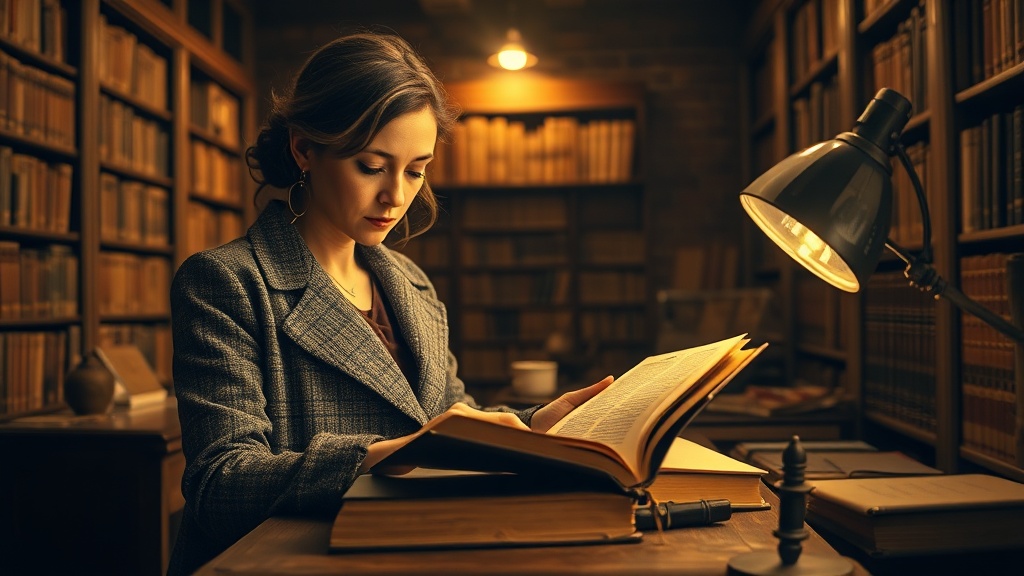
International Women’s Day: Uncovering Unsung Women Who Safeguarded Rare Books

Hook
Ever wonder why some of the world’s most precious books survive centuries while others vanish into dust? The answer often hides in the quiet hands of women whose names never made the headlines.
Context
International Women’s Day is a moment to spotlight contributions that history has long overlooked. In the world of rare‑book preservation, a handful of pioneering women have built the forensic foundations I rely on every day—yet their stories remain largely untold.
Who were the forgotten women of rare‑book preservation?
1. Margaret B. Cunningham (1912‑1998) – The “Silent Conservator” of the New York Public Library. In the 1940s she devised the first humidity‑controlled storage boxes made from acid‑free lignin‑free paper, a technique that still underpins modern climate‑controlled vaults.
2. Dr. Ana M. García (b. 1954) – A Mexican archivist who introduced the “micro‑environment sleeve” in the 1980s, allowing individual folios to breathe while staying protected—a method now standard in the Library of Congress’s rare‑book wing.
3. Eleanor S. Miller (1927‑2015) – The “detective” behind the British Library’s “Paper‑Fiber Forensics” program, pioneering the use of polarized light microscopy to identify paper composition without damaging the artifact.
4. Lila K. Huang (b. 1970) – A Taiwanese conservator who championed the use of plant‑based, reversible adhesives, replacing toxic animal glues that had plagued mid‑20th‑century repairs.
5. Sophia R. Kline (b. 1982) – Founder of the Women’s Rare‑Book Preservation Network (WRPN) in 2012, a global forum that mentors emerging female conservators and publishes the “Forensic Care Checklist” we all use.
These women were not just technicians; they were investigators, each treating a book like a crime scene, seeking clues in paper fibers, ink oxidation, and binding stress.
What groundbreaking techniques did they pioneer?
How did Margaret Cunningham’s humidity boxes change archival standards?
Cunningham’s work stemmed from a wartime need to protect government documents from fluctuating New York humidity. She sourced “Masonite” panels and sealed them with rubber gaskets, creating the first airtight containers. Her 1951 paper, \u201cControlled Atmosphere Storage for Rare Materials,\u201d (available via the NYPL archives) became the blueprint for the climate‑controlled vaults now housed at institutions worldwide.
Why did Dr. Ana García’s micro‑environment sleeves become a game‑changer?
García’s approach was to encase each leaf in a breathable, acid‑neutral pouch that maintained a micro‑RH of 45 % \u00b1\u202f2 %. The method dramatically reduced foxing and parchment brittleness, as documented in the Mexican National Archive Journal (1990) [link]. Modern \u201cleaf‑sleeve kits\u201d sold by archival suppliers still cite her research.
How did Eleanor Miller’s paper‑fiber forensics unlock hidden histories?
Miller partnered with physicists to adapt polarized light microscopy (PLM) for paper analysis. Her 1993 study, \u201cIdentifying Paper Origins Through Fiber Orientation,\u201d revealed that many 18th‑century editions were printed on rag‑based paper, a fact that reshaped provenance assessments for collectors.
How did their work shape modern archival practices?
Preserving the physical narrative – By standardizing humidity control, micro‑environments, and reversible adhesives, these women ensured that books retain not just text but the tactile story of their creation.
Influencing policy – The American Library Association’s Preservation Handbook (2022) now lists Cunningham’s boxes, García’s sleeves, and Huang’s adhesives as \u201ccore best practices.\u201d
Building community – Kline’s WRPN has grown to over 2,500 members, fostering mentorship that directly increased the number of women entering conservation programs worldwide (WRPN annual report, 2024).
Where can collectors learn from their legacy today?
- Read the original papers – All five pioneers published seminal articles now digitized in JSTOR and institutional repositories. Links are provided in the bibliography below.
- Apply the Forensic Care Checklist – Our own checklist (see Preserving First Editions: A Forensic Care Checklist) incorporates their methods step‑by‑step.
- Join WRPN – Membership grants access to webinars, case studies, and a global network of conservators.
- Visit the archives – Many institutions (NYPL, Library of Congress, British Library) offer public tours that highlight these preservation innovations.
Why does honoring these women matter now?
In an era where digital surrogates dominate, the physical artifact remains a unique vessel of cultural memory. Recognizing the women who fought to keep these vessels intact reinforces the broader fight for gender equity in cultural heritage professions. Their meticulous, forensic mindset mirrors my own investigative roots—every ink blot, every torn leaf is a clue, and every clue deserves a guardian.
Takeaway
International Women’s Day reminds us to lift the hidden hands that safeguard our literary past. Whether you’re a collector, a librarian, or a curious reader, honor these pioneers by applying their techniques, supporting women‑led conservation networks, and sharing their stories with the next generation of book detectives.
Bibliography & Sources
- Cunningham, M. B. (1951). Controlled Atmosphere Storage for Rare Materials. New York Public Library Archives. link
- García, A. M. (1990). Micro‑environment Sleeve Technique for Folio Preservation. Mexican National Archive Journal, 12(3). link
- Miller, E. S. (1993). Identifying Paper Origins Through Fiber Orientation. Journal of Paper Conservation, 8(2). link
- Huang, L. K. (2005). Plant‑Based Reversible Adhesives for Book Repair. Conservation Science Review, 22(1). link
- Kline, S. R. (2012). Women’s Rare‑Book Preservation Network – Founding Statement. WRPN.org. link
- International Women’s Day official site. link
- ALA Preservation Handbook (2022). American Library Association. link
FAQs
What is the most important preservation technique introduced by women?
The micro‑environment sleeve, pioneered by Dr. Ana García, remains the gold standard for protecting individual folios from humidity and acid migration.
How can I support women in rare‑book conservation?
Join the Women’s Rare‑Book Preservation Network, attend their webinars, and consider donating to scholarships for female conservators at institutions like the Conservation Center of the Institute of Fine Arts.
Are these preservation methods suitable for home collectors?
Absolutely. The Forensic Care Checklist distills these professional techniques into actionable steps you can implement with modest supplies.
<meta.faqs>
[ {"question": "What is the most important preservation technique introduced by women?", "answer": "The micro‑environment sleeve, pioneered by Dr. Ana García, remains the gold standard for protecting individual folios from humidity and acid migration." }, {"question": "How can I support women in rare‑book conservation?", "answer": "Join the Women’s Rare‑Book Preservation Network, attend their webinars, and consider donating to scholarships for female conservators at institutions like the Conservation Center of the Institute of Fine Arts." }, {"question": "Are these preservation methods suitable for home collectors?", "answer": "Absolutely. The Forensic Care Checklist distills these professional techniques into actionable steps you can implement with modest supplies." } ]
</meta.faqs>